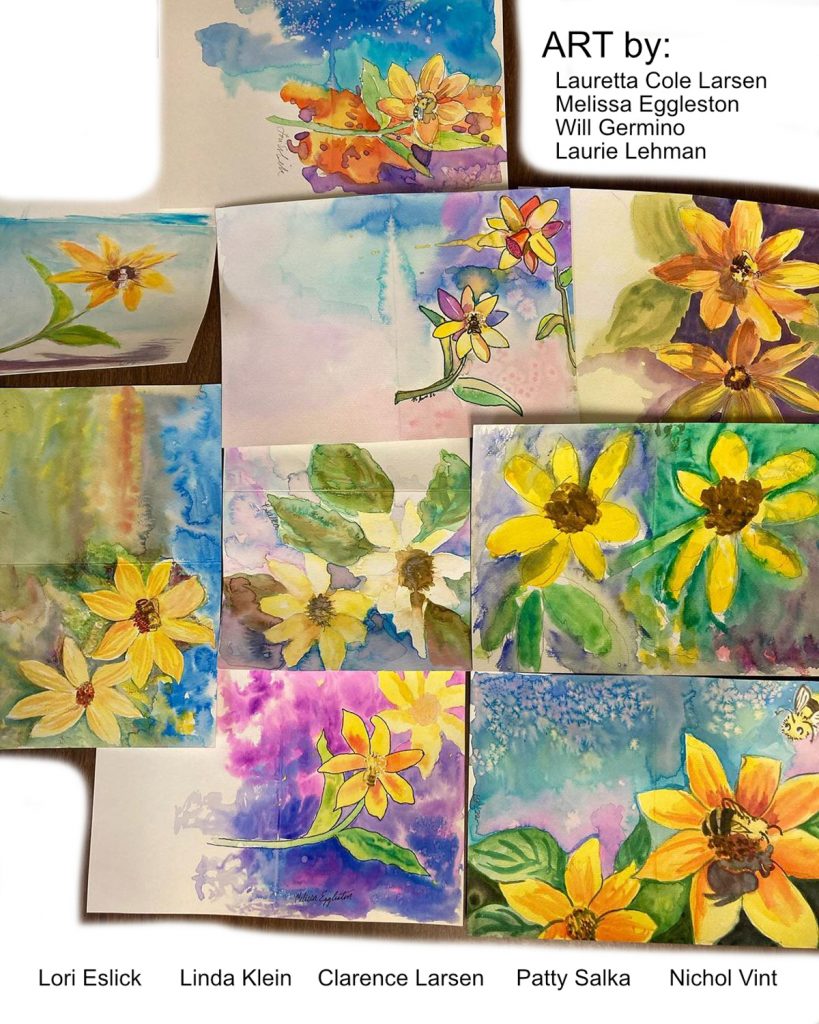
“Our sunflowers were done as our way of warming up to paint, but so much more: we painted and in our quiet moments of feeling the paint to paper, the qualities of our painting we silently thought of others in our world facing difficulties of war. The sunniness of our flowers and the blue sky behind them resembling the Ukraine flag, and how this is a hopeful sign to all. Especially a room of artists quietly painting and meditating while doing so.”
—Lori Eslick, Children’s Book Illustrator/Author. www.EslickART.com. The art was done by participants in a “Children’s Book Illustration” class conducted this month by Ms. Eslick in Lowell, Michigan.
Or is it four years, or five decades, but definitely when
the polar bears start swimming to New York
The sea groans and rumbles
As waves upon waves of human trash clog her up
She sniffles amidst the crushing silence
Sea snot collects on her waves
History starts to crumble
Our oldest trees cut down
Nature groans and shakes
In a futile effort to stop the abuse
The planet prepares itself for destruction
The pain is unlike anything she has ever experienced before
Crops shrivel up in the infernos that run rampant across the landscape
Such displays are necessary to attract humanity’s short attention span
Animals feel nature’s anguish
They flee North
Until they cannot go any further
More lives snuffed out by humanity’s greed
The most vulnerable of the population suffer
Heat waves overwhelm the wounded, elderly, and sick
Surely we did not mean to wage warfare on the defenseless
But it is only a matter of time before conditions deteriorate further
Schoolchildren sullenly trudge across the parched land
The sky turns black as clouds suddenly gather
They look up, hopeful for the touch of the fabled snowflake
Warm rain drizzles, then the omnipresent sun returns
In some places floods wash away human remains
Our ancestors disturbed by Nature’s wrath
They weep as they behold the desolate world around them
For the fate of the next generation
Art and Poem by Daniel Liu, age 16, New York.
Daniel Liu adds: “I am a sixteen year old writer that lives in New York. I am very passionate about the issue of climate change, as it is an enduring issue that grows ever larger with each generation and is deserving of attention from all of society. These poems are a testament to the various consequences of climate change in every aspect of society, from agriculture to insurance. To this extent, I hope that these poems are enough to inspire a sense of alarm for the Earth’s future, but just as importantly, hope that humanity can unify in order to reverse the ecological damage that has been done. It is in times of great crisis that innovation and change are at their peak, and humanity’s resilience is shown through our uplifting moments.”
The desperate family feels the vicious sting of betrayal
When Insurance blacklists the entire zip code
Businessmen reassure themselves of their morality
Accepting this debt will only cause their bankruptcy
But what of
The newborn baby, still fresh from the womb
The elderly grandparents, who have worked decades to afford the house
The first casualties of the consequences of the war humans wage on the planet
How long must the injustice go on
How many icebergs must melt
The gushing stream of the Earth’s blood
Will overwhelm us if change is not forthcoming
Art and poem by Daniel Liu, age 16, New York.
Daniel Liu adds:
“I am a sixteen year old writer that lives in New York. I am very passionate about the issue of climate change, as it is an enduring issue that grows ever larger with each generation and is deserving of attention from all of society. These poems are a testament to the various consequences of climate change in every aspect of society, from agriculture to insurance. To this extent, I hope that these poems are enough to inspire a sense of alarm for the Earth’s future, but just as importantly, hope that humanity can unify in order to reverse the ecological damage that has been done. It is in times of great crisis that innovation and change are at their peak, and humanity’s resilience is shown through our uplifting moments.”
By Fathima Nazer Karakkadan, h.s. sophomore from India, living in Kingdom of Saudi Arabia
There’s a certain tragic enchantment in crumbling bridges
A prominent result of our actions.
A beauty in empty swings and abandoned parks,
Of unattended grass and dusty books.
The world listens to no one,
Each day is a reminder of how mortal we are,
Truly insignificant in the course of happenings
The sun combusts red now,
A revengeful fire,
Calling the attention of the ignorant beings of then,
Who did not care.
Taps don’t drip water anymore, there are no tides,
But constant sobbing of the hopeless
And the sons who used to drink to their sins.
Writings of good and evil
On morality and wicked
Have all been torn away
By vicious forces at hand.
Desperate prayers are not a remedy
For the annihilating moon
And the constant danger
Of our benighted neglect.
By Fathima Nazer Karakkadan, a high school sophomore student from India, living in the Kingdom of Saudi Arabia.
Postscript: Fathima adds:
“To me, the biggest mystery in this world is its end. This is in no way a light topic, but everything must come to an end, and that includes our universe. And what better way to analyze it than to imagine it? ‘The Irreversible Apocalypse’ are my predictions on the course of events when the sun will combust, the sky will split and the world ceases to be. Those days are most probably filled with regret and remorse and indignant human beings who have no choice. When the world retaliates for what we’ve done to it, how could we ever stand a chance?”
Tang Li was born in the United States, and she speaks and learns to write in English, Mandarin, and French. She has had one-year horseback riding experience She is very fond of riding and taking care of horses, and she misses those good old days. She wants to be a veterinarian in the future; her dream hasn’t changed since she was four years old.
In Tang’s realistic fiction, Horse Dream, she used the main character Molly to realize her dream, by choosing an ideal location and a dream horse to ride. She began her creative writing by introducing Molly: “Hi. My name is Molly. I am ten years old and was born in Paris, Texas. Yes! It may sound crazy and this Paris even has an Eiffel Tower, just like the one in France. But this Eiffel Tower has a gigantic cowboy hat! My house is just a few blocks away from the Eiffel Tower.
“I have always dreamed of being a cowgirl. Horses are such beautiful animals! I begged mom and dad to sign me up for horseback riding lessons… In school, my favorite part was recess because I got to swing high up on the swings and to see the horse pasture on the other side of the school wall. My favorite horse was a horse named Fiona. She is a brown quarterback horse with a white mark shaped like a rhombus between her eyes. I always hoped to ride on Fiona someday.”
“My dad said he saw something in here yesterday,” Reeza said. “Amelia, when did you get here? Do you have insects in America? Ants? Worms? Caterpillars?”
“I got here a few days ago. Yeah, we have bugs.” I replied, trembling. “Do you like them?”
“Yeah, they’re cute. You might see a few in here today.”
Do I really want to go in there with all these slimy, creepy bugs? Yuck, I thought. But she seems nice and I’m finally meeting someone my age.
We were standing as tall as the grotto, a small cavern of rocks my grandparents gathered years ago from the Panay Gulf beach across the street. It was a house for various statues of animals carved by a local artist from the village. A frog, a turtle and a carabao stood strong, stationary, and well-preserved from the scorching Philippine sun. Reeza gently placed her left hand on the arch to peer inside. I did the same with my right hand, feeling secure touching the coarse, solid entrance.
“It smells in here. It’s been rainy this June.” Reeza pointed to the cracked ceiling as she carefully knelt in between the statues. “How long are you going to be here with your grandpa?”
“It’s cooler in here. I’ll be here until Sunday. Then to my aunts’ for school,” I replied, ducking my head in and kneeling on the prickly, pebbly ground. I gently wiped the sweat pouring off my forehead now that we were away from the morning sun. I wondered when I’ll stop sweating and get used to the heat like everyone else here.
We surveyed the black, grainy floor. My right hand unknowingly grabbed something furry and squishy on the grotto wall.
I let out a piercing yelp.
“What is it?”
“It was just moss. Sorry,” I said.
We returned to exploring the darkness. Then a deep, rumbling call echoed inside.
“Have you been to the beach?” Reeza asked. “Let’s go there tomorrow morning and see if the fishermen caught some sharks. I want a picture with it.”
Yuck, I thought. Sharks seem slimy.
Tookoo! Tookoo!* Big, bulging eyes glowed towards me.
“Eeeek!” I screamed and we hurriedly stepped back.
Gecko Tigbauan, Iloilo, Philippines
A gecko the size of my arm scampered out of the cavern, climbing up and blending in with the banana trees behind the grotto.
“He’s harmless,” Reeza replied. “He’s usually inside a house. He sleeps during the day and is up at night looking for bugs to eat.”
“What was he doing here?”
“Maybe cooling off,” Reeza said. “Do you guys have geckos where you come from?”
“None in Michigan.”
“We’re used to them. They’re everywhere here.”
House Geckos? Shark fishing? Bugs everywhere? Will I fit in?
We stooped back into the grotto. My gaping mouth caught the salty sweat running down my forehead. I swallowed and breathed deeply, relieving the cottonball feeling stuck in my throat. Reeza waved me in.
“I can’t. Bugs creep me out and I’m scared of geckos, sharks and whatever else is here,” I said, lowering my head towards my flip-flops. “Maybe I should just go home now.”
“Oh!” Reeza gasped, her finger pointing at me.
A gust of wind whistled and relieved us from this tropical heat. I slowly eyed the right side of my face without moving a muscle in my body. Something was dangling, gently caressing the side of my cheek.
“Run!”
We squealed, bumping into one another on the way out. We bolted out of the grotto and leapt across the front yard. My heart was pounding, my legs were wobbling forward, one after the other. Somehow, we managed to reach the driveway. We collapsed on the cement, panting, and clutching our heavy chests.
“Look!” I yelled, pointing to her back.
Reeza shrieked and pranced in a circle, her hands waving up in the air. She’s a girl on fire. As I peeled the snakeskin off from her shirt, she slumped down and brushed her body with her hands.
“Thank you,” Reeza said, panting.
We examined this leathery object.
“It’s actually soft.”
“So pale and long.”
“My teacher last year brought snakeskin to school. She told us that snakes molt or shed their skin in one piece. They do this when they’re growing,” I said.
“I didn’t know that,” Reeza replied, tilting her head. “Snakeskins don’t scare you, but geckos and little bugs do?”
“I guess not,” I said, giggling. “I’m just not used to the ones you have here. Not yet anyway. Snakeskin is one thing, but a real snake is…”
“Gross.”
“Jinx.”
We sat, laughing and crying with the snakeskin in between us.
I wonder what else we have in common, I thought.
“Do you like soccer?”
Playing Soccer in Pototan, Iloilo Province, the Philippines.
“I love soccer!” Reeza said, beaming. “Let me get my ball and see if anyone else wants to play. I’ll be right back.”
San Joaquin, Iloilo Province, Philippines (above)and A Boat in the Philippines (below)
Author’sNote: Tookoo! Tookoo! is the sound that a lizard makes.
Photos and story by Angelie Tumaghap Martzke, Michigan. She adds: “I was born in the Philippines and grew up part of my childhood there in my grandfather’s house... This story, set in the Iloilo Province, is inspired by my actual experiences there. Since I was 9-years old, I have gone back every two to three years and continue to speak my language of Kinaray-a. My background is in Social Work, receiving my Master’s degree in Social Work from Columbia University in 2008. I have worked with teens and adults providing individual, family and/or group therapy.”
Information is resistance. It will open our eyes. Awareness is change. The first step to solving a problem is acknowledging there is one. Let the existence of the climate crisis sink in. This is a reality check. Get out of your own heads. Snap out of it.
People’s lives are at stake. Climate change doesn’t affect everyone equally. People in power and people with privilege will not feel Mother Nature’s wrath the way minorities do. People will use their wealth and privilege as ‘band aids’ to block out destruction.
You can already see the effect that pollution is having on minorities in Canada. McGill Daily states, “In October 2020, over 250 Neskantaga residents were evacuated and transferred to a hotel in Thunder Bay after “an oily sheen was found in the Neskantaga water reservoir;” “high levels of hydrocarbons” were discovered in the water after testing.” The chemicals we created are destroying communities. They are festering in our waterways like tumors, spreading disease.
This destruction can also be seen through the construction of Line 3. Line 3 is a pipeline expansion that was just completed in September 2021. This pipeline will transport almost a million barrels of toxic tar sand oil per day from Alberta to Wisconsin. An oil spill would mean damage to coastal communities (near Lake Superior) and the wildlife, such as salmon and orca . StopLine3.org states, “Line 3 would violate the treaty rights of Anishinaabe peoples and nations in its path wild rice is a centerpiece of Anishinaabe culture, it grows in numerous watersheds Line 3 seeks to cross. It’s well past time to end the legacy of theft from and destruction of Indigenous peoples and territories.”
It is disgusting that our government allowed this pipeline to be built. They choose oil over preserving life! The people in power have to wake up! We have to find a new renewable resource. We have to act now. Researchers have found that we’ll likely cross the threshold for dangerous warming between 2027 and 2042. In 2042, I will only be 35 years old.
If you leave it up to my generation, it will be too late. We must all do better. Urge your elected officials to remove Line 3. Urge them to create a plan to invest in solar, wind or hydropower. We must switch to a renewable resource now! Increase the carbon tax. Instead of using tax dollars to invest in Line 3, the government should have used them to benefit the future of society. The Canadian government has to make stopping climate change a priority.
I want to help stop this but I feel so powerless. Corporations value making money over the future of their children. They value making money over minorities’ lives. Capitalism has caused people to become so consumed with greed. They are putting lives at stake. Mother Nature is bleeding. Humans are tearing out her skin and cutting her flesh. The earth is coughing up ash and choking on our greed. When will the earth’s heart give out?
This is my final plea to the people in power. You are selfish. You are killing us. You have already ruined the lives of countless Indigenous communities. You may not be affected by climate change right now but Indigenous people are. My generation will be. Our futures will rise up in flames. I don’t understand why you can be so selfish? Was it worth it? I hope you’re happy. You are exchanging lives for dollars. I hope it’s worth it.
We have to end the cycle of greed and suffering. Information is resistance. Open your eyes. Awareness is change. Use this awareness to get out of your own heads. Remove the shackles of greed that are binding you to your destructive choices. Think of the world around you. Here is a reality check.