Category Archives: International

Women in S.T.E.M. Contest Winners

We are pleased to share with you the four winning entries from the Soroptimist International of Eugene and Skipping Stones sponsored Women in S.T.E.M. Writing Contest held recently. The winners were recognized at an awards ceremony held in Eugene on March 8th, the International Women’s Day. You can also read these in our Spring 2023 issue.


New Year’s Resolution

New Year’s Resolution

By Vajra Vanukuri, age 11, grade 6, California.


Eleven-year-old Kristina shouted on the phone. Vera, her mother, packing lunches for her two children, heard the shouting and dashed to Kristina. Kristina gave her the phone. Kristina was talking to her father at his doctor’s office in Moscow, Russia. 

“Vlad, why is Kristina shouting?” began Vera in Russian.

“Vera, this afternoon I must attend a conference at her school. But I cannot be there. I have an important meeting.”

“How can you do this!” she asked.

“Why don’t you attend?” he replied.

“How can I go?”

“You are not going to a forest. You’ll be fine!”

“I know, but I can’t speak English properly. It’s an ironclad rule at her school.”

“You can manage. GO!”

She turned to Kristina, “Kristina, your father is busy. I will come instead of him.”

Kristina shouted, “Mother, you can’t speak English. How can you come to the conference? NO!” She plowed through her mother and ran sobbing. But Vera convinced Kristina. As there was no option, she agreed and left for school. 

Vera was depressed. She felt that if only she knew English, she could avoid such situations. But how is it possible for me to learn English while balancing so many tasks? Suddenly, she realized that Andrei was getting late, so she got him ready and walked him to school.

In the afternoon, Vera attended the conference at the school. All the teachers and staff were cordial to Vera. Kristina kept shushing her mother. All she said were phrases like, “You are embarrassing!”, “Stop talking!”, and “You do not know English!” Ignoring her daughter’s comments, Vera managed to keep her cool and finished the meeting. 

After delivering a cake to a customer Vera went home to start dinner. At home, she asked her mother-in-law where Kristina was. She said that Kristina had gone to study with her friends. While they were talking, Kristina walked in. 

Vera asked, “Why did you go out? You can study at home, you know!”

“I have doubts about English Literature. Can YOU clarify them?” Kristina said with an arrogant tone.

Vera went to the kitchen as she sobbed quietly. Everyone thinks that kids are innocent. Is this the definition of innocence—hurting parents with an inconsiderate tone?

At dinner, Vera explained Kristina’s deplorable behavior to Vlad. But he chuckled and said, “Well, if you knew English, Kristina would not have to suffer like this.” Then he added, “This food is delicious. At least you are good at something!”

That night, Vera was tossing and turning as she thought about her hurt feelings. Like father, like daughter. If my husband won’t respect me, then how can my children respect me? I must learn English. But how is it possible with all my responsibilities? 

*  *  *

As the months went, Vera’s nephew in London was engaged. One day, she got a call from her sister in England. Her sister pleaded Vera to come and help her with the wedding arrangements. 

Vera said, “Margarita, I’d love to come, but you know that I am balancing a tight schedule.” But as Margarita requested over and over again, Vera agreed. 

When Vera asked Vlad if they could go, Vlad said, “I could get a week off. I can come with the kids for the marriage. You could go now and help your sister.” 

Vera worried, but Vlad said that his mom would take care of the kids.

To get to London alone was a challenge for Vera. Finally, she arrived at her sister’s home. Margarita greeted her with a warm welcome. After two days, it was New Year’s Eve. Margarita hosted a party for the bride’s family. It was really boring for Vera because she could not understand their English conversation. Then, the topic about New Year’s Resolutions came. Vera heard the words but didn’t know what to say. So, she kept quiet. 


Illustration by Katherine Han, age 18, high school senior, Texas.

That night, she was thinking: Why can’t I make a resolution? What should it be? Then, an idea struck her head. I will learn English. All night, she tried to figure out how to learn English. 

The next day, she saw an advert from LCC, The London Language Center, on the TV. They offered English classes to newcomers. 

After her sister left, Vera called their number and gathered all the information. In the afternoon, when she went to the LLC, the receptionist said,

“The class is a four-week course; it starts in ten minutes. If you want, you can join it.” Vera paid the fee and sat in the class.

Vera didn’t tell anyone about this. Every day, she managed to attend the class when the family was away. She followed every single detail. While commuting, she’d read anything in English. She tried to communicate with her classmates in English. The instructor was impressed and encouraged her immensely. 

Sometimes, Vera shared her food with her classmates. They loved her cooking and appreciated her. One day, she told them of her small cooking business. The instructor said that she was an entrepreneur. Everyone clapped and cheered for Vera, and praised her. That made her very happy.

One day, Margarita’s daughter, Victoria, was coming back from college and saw Vera on the street. She asked her of her whereabouts. Vera explained the whole story and requested Victoria to keep it a secret. Victoria promised Vera that she’d help fulfill her New Year’s resolution. Vera received English movies from Victoria and watched them in free time. She used every single opportunity she could to immerse herself. 

Vera was extremely busy and tired with all the wedding preparations and her English classes. As the wedding approached, Vlad and the children came to England. Vera was happy to see her children but worried about attending her classes. Victoria noticed her stress and asked, “Why are you looking so worried?”

“How can I attend the classes when everyone is home?”

“How many days are left?”

“Three days!”

“Don’t worry. I’ll see what I can do to help.” 

The next day, Victoria went to LLC and arranged video classes for Vera. For the next two days, Vera attended her class in the bathroom! But the final test was on the actual wedding day. The test was a five-minute speech in English. If they did well, the students would receive a certificate of graduation. 

Vera decided she not to attend the test. At night, Victoria noticed her sadness. “What’s wrong?” asked Victoria.

“I can’t attend the test because of the wedding. This is the end of the line for me,” said Vera. 

That night, Victoria thought of an idea. Next morning, she called LLC and talked to the instructor. 

Everyone was running around with joy as they busily rushed to prepare for the big gathering. Depressed, Vera also got ready. As the wedding ceremony began, she saw her teacher and classmates in the hall.

During the dinner, it was time for family members to make toasts to the bride and the groom. After Margarita, Victoria encouraged Vera to say something. Everyone started encouraging her. Before she could speak, Vlad intervened, “My wife does not know English…” 

But Vera interrupted him, “Vlad, may I speak?” And before he could respond, she stood and started:

Meera … Kevin … Marriage is a beautiful thing. It is a special friendship between two people who are equal. Sometimes, couples don’t know how the other one feels. Family can never be judgmental. Family should never put you down, should never make you feel small. Family is the only one who will never laugh at your weaknesses. Family is the place where you will always get care and friendship. Meera and Kevin, I wish you all the best. Thank you.” 

After the speech, everyone gave a round of applause except Kristina and Vlad. They both felt shameful for having belittled Vera. 

The instructor stood and said, “Vera, you passed and have graduated from the four-week English course of LLC. Excellent job!”

“How is it possible?” Vera asked.

“Victoria convinced me to grade you here. It is a surprise for you,” the instructor said.

“Thank you, Victoria, for helping me fulfill my Resolution,” said Vera.

“I know you worked very hard for this. You are great!” said Victoria.

Kristina and Vlad went to Vera and apologized. Vera was so happy she had fulfilled her New Year’s Resolution. 

The family went back home to Moscow after a few days. Vera now feels, With determination, anything is possible.” 

—Vajra Vanukuri, age 11, grade 6, California. He adds: “I enjoy reading and I have a passion for writing stories. I like playing Soccer. I also practice Yoga, and Taekwondo, currently in the green belt. I aspire to be an environment and human rights lawyer when I grow up.

Illustration by Katherine Han, age 18, high school senior, Texas.

Peace in Ukraine

Peace in Ukraine

Could we find a peaceful resolution to this conflict based on the Swiss model?

Recently I was on a Christian retreat in Switzerland with a group of young people. We were in a room overlooking Lake Geneva and the majestic Alps, yet everyone was worried about war in Ukraine. One of the young people present, a Swiss woman named Anne-Marie, appeared very sad to see so much suffering in Ukraine. “Ordinary families in their thousands are losing their homes and becoming refugees,” she said.

“The Americans fought wars in Vietnam, in Iraq and in Afghanistan. What did they achieve? Nothing!” another woman, Christèle, said. “What hope is there for the Russians and the Ukrainians to find any solution by killing one another?  This is so stupid! In the end they have to find a solution by negotiation. If they are going to talk and negotiate after so much killing and so much destruction why don’t they do that before those killings and before all that suffering?” 

“This is common sense, but common sense is no longer common!” came from the back of the room. It was a man called Michael who spoke. He added: “Of course in the end they have to find common ground and some common interest through negotiations. The Ukrainians and the Russians have to live next to each other. They are neighbours. They cannot change their  geography and their location!”

Anne-Marie answered: “Ukraine is a small country living beside a nuclear-armed Russia. Therefore Ukraine should not give Russia any excuse for aggression. Ukraine could and should follow the Swiss model.”  I was intrigued by this, so I asked her what she meant. She said: “Our country is not a member of NATO. We are not in the European Union. We are not in the Eurozone. We have our own currency. Yet we are able to trade with Europe as well as with the rest of the world. Why can’t Ukrainians do the same? Our country was neutral in the first world war and the second world war. Why can’t Ukrainians remain neutral and friendly with all countries? Switzerland has no enemies. All countries are our friends! That is what I call the Swiss model.”

“But hasn’t there been a long-standing dispute between the central government of Ukraine and its Russian-speaking population of the east and the south?” I asked. “Hasn’t there been an ongoing civil war between the Ukrainian-speaking and the Russian-speaking parts of the country? How do you bring reconciliation between them?”

Anne-Marie said: “Again they need to follow the Swiss model. We have four national languages – German, French, Italian and Romansh. They are all official Swiss languages. Ukraine could make Ukrainian and Russian two equally important official languages. Linguistic diversity should be celebrated. Multiple languages bring cultural richness. In Switzerland a large proportion of administrative functions are decentralised. We have 22 self-governing cantons. Each one of them has a great deal of autonomy. Many national issues are settled by referendum. Our prime ministers or presidents are not so important. Do you know who the president or prime minister of Switzerland is?”

“No, I don’t,” I replied.

“Why should you know?” responded Anne-Marie. “This is the Swiss model. Our constitution doesn’t give a huge amount of power to the central government. We live peacefully within our country and peacefully with our neighbours. Why can’t Ukraine do the same? War is not a solution.”

“But the Ukrainians say that this is ‘Putin’s war’,” I said. “The US and European governments, as well as much of the western media, believe that this is Putin’s war. What do you say to them?”

“It takes two to tango!” Anne-Marie replied. “The Russians blame the Ukrainians, and the Ukrainians blame the Russians. We have to rise above the blame game if we want peace. Both parties need to compromise! The word ‘compromise’ is misunderstood. In fact it is a positive concept. It means ‘promising together’. When two warring sides come together, they must stand on the middle ground and find their common interest and agree together, and then it is a true compromise.”

Anne-Marie took a deep breath. After a moment’s pause, she said: “I want to see the children of Ukraine united with their parents. I want to see millions of refugees going back to their homes. I want to see the old and the sick being taken care of. War is futile. No one will win. Everyone will lose. What is the point?” 

I was impressed by Anne-Marie’s account of the Swiss achievement in creating a peaceful, multilingual and multicultural country. I thought that this could be the way to peace not only in Ukraine, but in the whole world. 

We looked out at Lake Geneva and the amazing Alps. They were totally at peace! And in their subtle ways they too were calling for peace. 

—Satish Kumar is the Editor Emeritus of Resurgence Magazine, published from United Kingdom. He is the author of Pilgrimage for Peace, available from www.resurgence.org/shop Photo of Satish Kumar by Daniel Elkan. This article has been reproduced with permission from Resurgence & Ecologist Magazine, Issue #335.


Reflection

Reflection


“RUN” she said to her child, before her voice drowned out.

There was a moment of silence, before another shot fired

The little boy crouched behind a rock and waited

For he longed to return home, but knew he couldn’t 


Amidst the chaos, the bloodshed, the violence and the terrors

He remained calm, as calm as can be

He stared into a puddle filled with muddy red water

And it showed him the world; our world, of uncertainty 


Screams of horror echoed through the alleys

The dead lay scattered on the roads

There was aggression, there was unimaginable loss 

There was fear, but no signs of remorse 


But the shrieks were deafened and the wallows silenced

By his plea for justice, and his cries for help 

For the little boy of tender seven (or eight perhaps)

Merely longed to be anywhere else 


He might have been you, he might have been me 

Leaving everything behind, being forced to flee 

To seek asylum in a place unknown to him 

To escape his home, become a refugee 


But the little boy stood

Stood firm, like a boulder

He had found courage, even when the darkness reflected before him

He held on tight to his reality, for he knew if he didn’t 

He’d find himself slip into a world much colder  

—Aliya S., age 13, grade 8, Mumbai, India.

Making Peace in Corona

Making Peace in Corona

During 2020, when Corona struck and classes were split into pods and cast outdoors, where were you and what were you studying? 

One group of students on a kibbutz in Northern Israel was learning how to make peace. Facilitated by the Jerusalem Peace Builders, fifteen teenagers with varying degrees of piercings, torn jeans and loud colors in their hair, sat in an enormous circle in the old staff parking-lot-turned-makeshift-classroom adapted for the pandemic. 

Jerusalem Peace Builders (JPB) is an interfaith organization that brings together youth from different backgrounds, from Jerusalem, Israel, Palestine, and the United States, to create meaningful encounters. The first session is held separately at each school so students can start to build important dialogue skills such as active listening and empathy before meeting each other. 

This workshop began by exploring personal identity. They asked questions like, ‘Who are you?’ ‘What makes you unique?’ Important questions for teens who are about to get to know kids seemingly so different from themselves.


Just before the lunch break, the group played a game. Sarah, one of the facilitators, a quiet, young woman with silky, dark hair and skin, and deep brown eyes, sat inside the circle. The other facilitator, Yardena, taller and chattier, asked the questions and recorded the answers on a portable white board.

Where was Sarah from? What languages did she speak? How much education did she have? What did she study? Was she married? Did she have kids? 

What kind of assumptions do we make about people upon meeting them?

At first glance, it was hard to peg Sarah. She was most definitely from the Middle East, but nothing about her appearance, her accent, or even her name, indicated whether she was more likely to be Arab or Jewish. 

As Yardena posed the questions, students’ answers spanned the spectrum. She was from Egypt, from France, from Jerusalem, or maybe Ashkelon. She spoke English, Hebrew, and maybe Arabic. Perhaps Italian. She was a teacher, a lawyer, or a social worker. 

Michael had been a student the year before in the ninth grade English-speakers club. Wild haired with thick glasses and fiercely competitive, English came easily to Michael and he was used to winning. When he attended his first Model UN last year, he walked away with second prize. “It’s easy,” he said after with a wink and a dismissive wave of his hands. “You just need to speak a lot and pretend you know what you’re talking about.”

Michael was sure he had this game. He pulled his teacher aside. “She’s Arab, right?” It made sense since it was a coexistence workshop and Yardena, Sarah’s partner, was clearly Jewish.

Still, Michael fell into all the traps: If she was Arab, she must be poorly educated. But she was so articulate, so she must be wealthy and worldly, with some foreign Arab Passport. Jordan? Egypt? Certainly not Palestinian.

When Sarah shared that she was in fact Palestinian, Michael’s face twisted. He didn’t always take kindly to being corrected, but there was no denying who she was. As it turned out, she was from East Jerusalem, and had no passport at all. 

“Well, that’s a choice,” Michael shot back. “East Jerusalem Palestinians don’t WANT Israeli passports because they don’t accept the State of Israel.”

“There are Palestinians like that,” Sarah conceded, “But many people like me want them so we can live a normal life. Unfortunately, the passports are not easy to get. After we apply for a passport, it can take years to receive an answer from the government, and then fewer than half of the requests are even approved. Without a passport, I’m not a citizen of any country. I’m not free to travel anywhere in the world.” 

Michael’s second assumption was also shattered. “Palestinians are the most educated Arab population in the world. Especially the women,” Sarah said.

“Really?” Michael raised his thick eyebrows till they reached his fluffy mop of hair.

Sarah’s smile was more conciliatory than cynical. “Well sure. We can’t travel and there aren’t so many jobs. What else do we have to do with our lives? So, we study.”

Michael didn’t speak again as Sarah answered the rest of their questions. She wasn’t married, no kids. She’d been studying physics, but when she got involved with JPB, she decided to dedicate her life to helping promote co-existence. She loved traveling to schools and meeting students with such different backgrounds than hers and sharing her story. 

During the break, several students stayed to chat with Sarah, foregoing their lunch and only free time. She patiently answered their questions and asked some of her own. The rest of the day the students continued to explore identity. They were asked to map out all the things that made them who they were and highlight those that defined them best. As they discovered, how they define themselves—dancer, student, good friend—changed depending on the day or the situation, or their stage of life. 

At the end of the session, students were asked to share something they were taking away from the day. When it came to Michael’s turn, the other kids stepped in close, eyebrows raised in anticipation of his witty, cynical remarks.

Michael glanced down and then looked at Sarah. He smiled and joined his hands together in a rare gesture of gratitude. “Today I learned that I don’t know everything, and that’s okay.”

The next day, three ninth graders were diagnosed with Corona and the whole school went home for what would be the next eight months. To the great dismay of both teachers and students, their first JPB workshop was their last. 

But Covid has taught us at least two important things. First, we’re all in this together. Second, we must constantly adapt to an ever-changing world. 

Sarah gave up her whole career path to pursue peace. And Michael was able in one day to rethink everything he believed about people. What have you learned in Covid? And how do you plan to use it to change the world?

       —Emily Singer, Israel. She adds: “I am a writer and English teacher in Northern Israel, where I have a special passion for bringing students together from different ethnic, religious and cultural backgrounds to help them appreciate diversity and develop important negotiation and peace-making skills… In 2018, I published my first children’s novel, “Gilgul I: Re-Dedication.”  

Sunflowers and Thoughts of Ukraine

Sunflowers and Thoughts of Ukraine

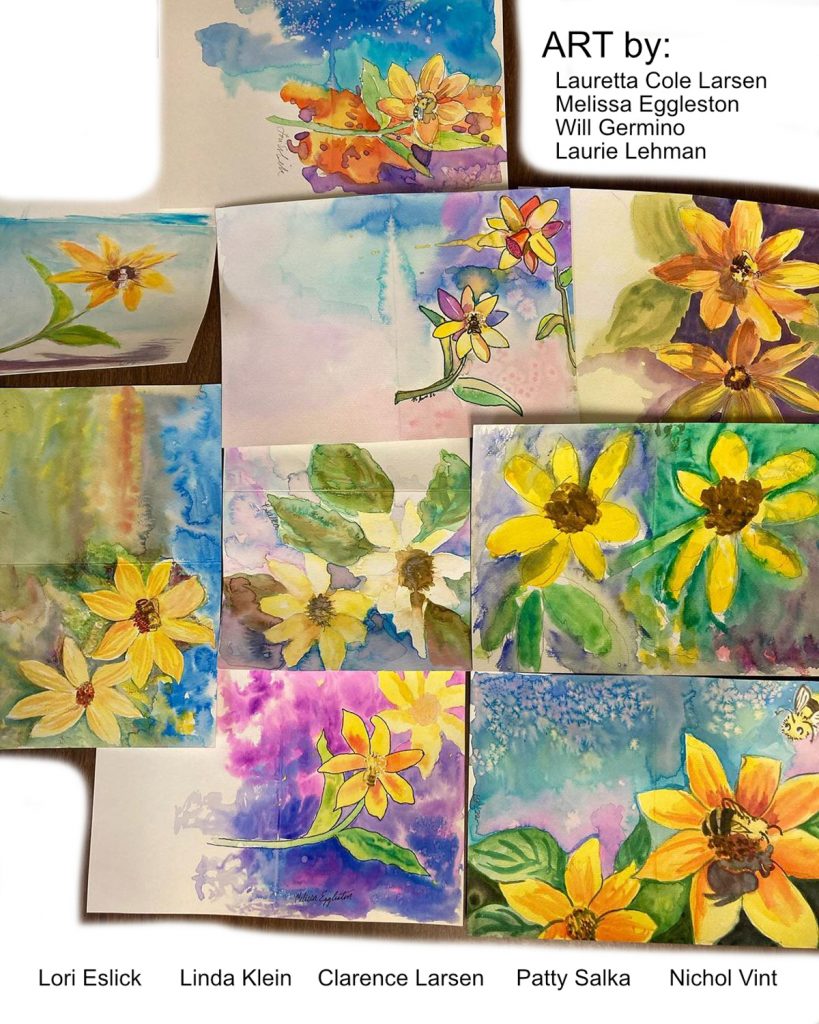
“Our sunflowers were done as our way of warming up to paint, but so much more: we painted and in our quiet moments of feeling the paint to paper, the qualities of our painting we silently thought of others in our world facing difficulties of war. The sunniness of our flowers and the blue sky behind them resembling the Ukraine flag, and how this is a hopeful sign to all. Especially a room of artists quietly painting and meditating while doing so.”

—Lori Eslick, Children’s Book Illustrator/Author. www.EslickART.com.  The art was done by participants in a “Children’s Book Illustration” class conducted this month by Ms. Eslick in Lowell, Michigan.

Kaleidoscope of Freedom

“After learning about the war in Ukraine, I was immediately worried about my grandfather and his wife, who live in Ukraine. At first, I felt that there was little I could do to help the Ukrainian people. But then I realized how art can be an important tool to show support for Ukraine during their fight to protect their land and homes from invaders. In my digital artwork ‘Kaleidoscope of Freedom,’ the center is the Ukrainian flag surrounded by the flags of countries that stand with Ukraine. It expresses the message that the people of Ukraine are not alone in the fight for their land and freedom.”

By Camille Campbell, Age 17, Arizona. Also see Camille’s poem COLORS OF UKRAINE and art published earlier on this website. She adds: “I’ve printed over 5,000 stickers with my art for rallies in Arizona, California and New York. The digital art is based on my silk art (the Ukrainian painting technique) and conveys the message that many countries of the world support Ukraine.” The donations that people make at these rallies support the Ukraine cause.


The Most Precious Gift

By Yarynka Yarosh, age 15, grade 9, Kyiv, Ukraine.

Standing near the window in her room, Christine cried quietly. She had long ago learned to wail silently so that no one would hear. Especially Mom. Or maybe she had just spent all her loud tears. Sometimes, after a series of such noiseless sobs, her pillow was too wet to sleep upon. Now those silent, salty streams were there once more, flowing down her cheeks, sprinkling her favorite violet raglan. 

Down there, in the yard, her friends are playing volleyball. Olenka serves the ball to Max, he hurls it over the net at Slavko, but Slavko palms the ball back skillfully. Twins Marusya and Oles` back him up closely. The whole team was there, except Christine!

The last time, they had played together was at the start of November, before the first snow. Then came that long and cold winter when Christine fell ill. Now, all the danger was past her, but she still couldn’t play. So every single day she just stood at her window, hidden behind the curtain and watched the exciting game. Her friends shouted for her every time they went out, but she rejected all invitations. She had no difficulty running. No, there was another reason—she just couldn’t confide in them. 

Christine sighed and sat on her bed, burying her head into her hands. Not a single hair under her fingers.

Last year had changed Christine’s life radically, ruining plans, dreams. The hospital room, IV`s, doctors, that awful laser lamp, endless chemos were again flickering before her eyes. Christine had no wish to replay all those dreadful months in her head, so she shook her head like she used to do before all that when she still had her beautiful hair. Oh, she was so proud of it! She had the longest hair in her year! And now she has nothing, but plenty of unpleasant thoughts scurrying in her head, like a scattered jigsaw puzzle. Christine was so full of self-pity that she started to cry again. After all this, she had learned to bear physical pain, but not the absence of her chestnut curls.

Oh, how she wanted to run with the “Volley Sixth” again, but…

Christine didn’t want her friends to see her without hair—anything but that! Her pals still had no idea that she was now bald—her parents bought her a wig so that no one would ever know.

Illustration by Yarynka Yarosh, age 15, grade 9, Kyiv, Ukraine

Christine got up and returned to the window. The field was now ringing with laughter—Slavko had just returned the ball in an unusual manner, locking his fingers in a weird knot. Christine poked her head out of her hidey-hole behind a curtain and imagined herself running over the field with her friends. There she is, taking a pass from Slavko, then feeding the ball out to Olenka and running for it just in time to catch a master shoot from Oles`, and then…

Everybody at the field was suddenly staring at her, at her window. Five confused faces. Absent-mindedly Christine scratched her head and suddenly the chills went up her spine… She had forgotten to put her wig on! She usually went about the flat without her fake hair and watched the game from behind the curtain. Today, however, she got so carried away she completely forgot to mind the “danger zone”.

Realizing that her friends saw her baldness the girl yelped and hid her face in her hands. Then she darted away from the window, fell on her bed, and burst into tears. Tomorrow’s her birthday and all the members of “Volley Sixth” were planning to visit—that was the most tragic thing of all!

Her Mom came into the room, alarmed.

“I`m the only bald person in my class! No, in the whole school, in the whole city!” cried Christine loudly, like the moment she was told about her diagnosis. “I don’t want any party on my birthday!” 

Mom hugged her tenderly. “But your hair will grow back, for sure, my skylark,” she soothed. 

“I can’t speak to them normally, knowing they saw me bald!” 

“If they are really and truly your friends, that should mean nothing to them,” she responded. 

But does she really have… true friends?

That night Christine had a beautiful dream. 

“Come on, Christine, serve it! That’s my girl!” shouted Slavko. 

“It’s so good to play volleyball with my friends!” Christine was rejoicing, serving the ball on the other half of the field. Suddenly, she saw it hurtling towards her. She wanted to break it, but her knees quaked and felt like cotton…

Somebody touched her shoulder very softly. Christine opened her eyes and instantly squeezed them tightly shut, hiding from the tickling morning light… Mom and Dad were standing near her bed, smiling and holding a present. So she had only dreamt about the game, how sad!

“Ding-dong,” rang the entry phone in a while. Christine quickly slipped her wig on. 

And there they were! Olenka, Slavko, Maxim, Oles` and Marusya. They had come empty-handed, and for some reason, were all wearing hats. 

 “Well, as agreed! On the count of three,” cried Slavko. “One, two, three!”

“Happy birthday!” And they swept off their hats as one.

They all had clean-shaven their heads! 

And they hugged the birthday girl, all at once.

That was the best birthday party Christine ever had! 

After the birthday treats, “Volley Sixth,” now fully complete, went to the sports ground before Christine`s window. Now Christine had difficulty identifying her friends on the field, she still hadn’t got over their new hairstyles. 

Then she remembered her dream. Now she couldn’t recall whether she had her curls there or not. Not that it had any importance now. She was quite happy without her hair now, for she had true friends.

By Yarynka Yarosh, age 15, studies in grade 9, Kyiv, Ukraine.

Yarynka writes, “I like painting, playing piano, reading, speaking with my family about anything, writing poetry, and stories, of course. I’m from Ukraine, and I want peace in the whole world, and for ourselves.

“On the 9th of March, we were forced to leave our home city, beautiful Kyiv (because of the Russian invasion)… Now my family and I are in a safe place, and I’m so thankful to God that we are still alive! But my grandparents are still in Kyiv. Please, pray for them!

“I was really surprised, when I read your email (of acceptance). I’m thankful for your positive response. You made me happy and gave me more confidence and hope 🙂 Ukraine needs your prayers, we feel your emotional support.”

Threats, Not Peace!

By Delaney Sheldon, age 14, grade 8, Virginia


Threats, not peace
Threats of creating what we fear most—a Third World tragedy
Threats of cutting the strings that connect us all together
Threats of destroying people’s land
People’s territory

Forget about peace
Why doesn’t peace ever show up?
Why is humanity always one step from falling off the steepest cliff?
Why do we sabotage ourselves and ruin others?
Why does publicity break us down? 

Fake news
Exaggerated news
REAL news
This news is very real
This news disrupts all peace that ever could be

So, what are we supposed to do?
Fight?
That’s not peace
Do we cut them off from the world?
And risk getting cut off too?
Definitely, not peace

Why should we even save them?
What have they done for us? 
If we throw the lifesaver to them in the deep water 
We could drown instead, sink straight to the bottom

But humans should save each other
Give them air
Bring them to the surface
Save them from their greatest fears

It’s our job as human beings
To let our humanity show
And to try to have peace on Earth
Because peace unites us all as one

Celebrating Women’s History

Princess Diana (1961-1997)

Princess Diana (1961-1997). Portrait by Jon Bush, Massachusetts.

“Carry out a random act of kindness, with no expectation of reward, safe in the knowledge that one day someone might do the same for you.”

—Diana, Princess of Wales (1961-1997). She was a member of the British Royal Family and mother of Prince William and Prince Harry. Her kindness, activism and position made her an international icon.


Justice Ruth Bader Ginsburg

Portrait of Justice Ruth Bader Ginsberg by artist Alix Mosieur of Loraine, Oregon.
Ruth Bader Ginsburg (1933-2020) served as an associate justice of the U. S. Supreme Court for 27 years. She was appointed by President Clinton and became the second woman to serve in this important judicial capacity after Sandra Day O’Connor. Justice Ginsburg was a well-known champion of gender equality and women’s rights. She died on September 18th, 2020, at the age of 87, after her battle with pancreatic cancer. You might like to watch RBG (2018), a documentary about her life. 

Rosa Parks (Feb. 4, 1913 – Oct. 24, 2005)

Dr. Jean Moule (sitting next to Rosa’s statue outside the Eugene LTD Bus Station, above) writes in her Skipping Stones magazine (April – May 2015) column, “Rosa Parks (Feb. 4, 1913 – Oct. 24, 2005) has become a symbol of the Civil Rights Movement and an international icon. She is an image of one lone person taking a stance that made a very big difference. She was sitting in a part of the bus that allowed Colored (African American) people unless it was needed for a White rider. When she was asked to move back to make room for a White passenger she would not. Rosa was 42 years old at the time and she was no more tired than anyone would be after a long day of work.

Rosa said, “I did not want to be mistreated, I did not want to be deprived of a seat that I had paid for. It was just time… there was opportunity for me to take a stand to express the way I felt about being treated in that manner. I had not planned to get arrested. I had plenty to do without having to end up in jail. But when I had to face that decision, I didn’t hesitate to do so because I felt that we had endured that too long. The more we gave in, the more we complied with that kind of treatment, the more oppressive it became.”

You can read Professor Jean Moule’s Nana Jean Columns in her latest book, Seeking Warmth and Light. FMI moulej@oregonstate.edu.